Pricing a home in Metro Vancouver is part science, part strategy, and part local nuance. Whether you own a detached home in Kitsilano, a townhouse in Mount Pleasant, or a high-rise condo in Yaletown, putting the right number on your listing can be the single factor between selling quickly at top dollar or watching your listing sit on the market.
Setting the right price requires evaluating several key factors to get your home sold efficiently and profitably.
1. Understand the Current Market Micro-Climate
Vancouver real estate is famous for shifting quickly. Beyond national interest rates, what matters most is the specific supply and demand dynamics in your micro-market.
Pay attention to your property's Sales-to-Active Listings Ratio:
Sellers' Market (above 20%): High buyer demand and lower inventory. Properties sell quickly, often with multiple offers.
Balanced Market (12% to 20%): Supply and demand are well matched, allowing prices to remain steady.
Buyers' Market (below 12%): Buyers have more options and leverage, while properties take longer to sell.
Note: Detached homes, townhomes, and condos often move in entirely different market cycles, even within the same neighborhood.
2. Look Beyond BC Assessment Values
One of the most common mistakes local sellers make is relying on their annual BC Assessment notice to set their listing price.
BC Assessment values are based on market data from July 1st of the previous year and are published in January. By the time you receive your property assessment, the data is already six to twelve months behind current market conditions. Use it only as a rough baseline, never as your active listing price.
3. Conduct a Deep-Dive Comparative Market Analysis (CMA)
To find your home’s true current value, evaluate recent neighborhood sales (the "comps") rather than active listings. Active listings reflect what other sellers hope to get, while sold properties reveal what buyers are actively paying.
Look for comparable properties using these criteria:
Proximity: Within 3–5 blocks in high-density areas, or the immediate sub-neighborhood.
Recency: Properties sold within the last 30 to 90 days.
Property Specifics: Match square footage, layout, floor level, view, exposure, and age.
Strata Features: For condos and townhomes, factor in monthly maintenance fees, strata contingency reserves, and upcoming special levies.
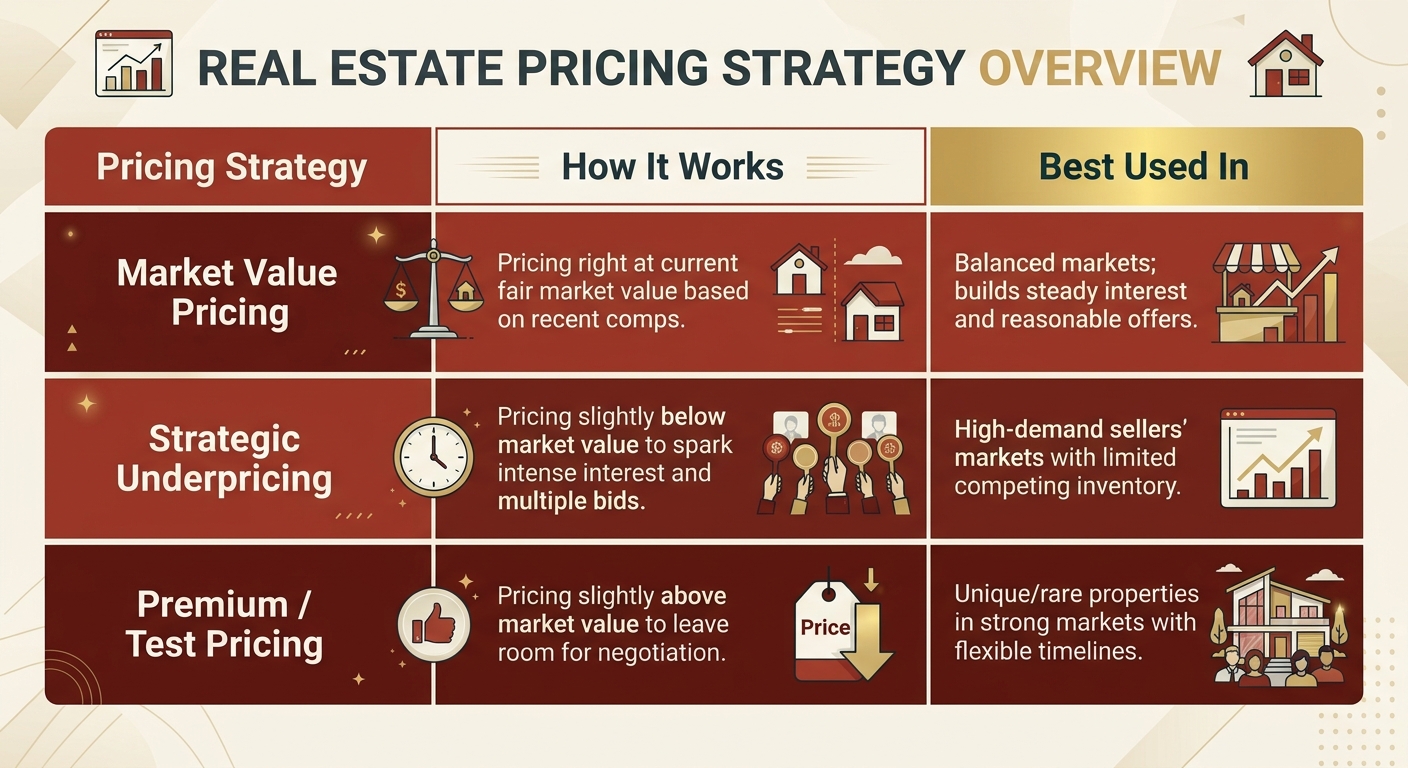
4. Choose Your Pricing Strategy
Depending on market conditions and your timeline, select a strategic pricing approach:
5. Account for Vancouver Specifics
A few unique local details can significantly swing your home's valuation:
View & Elevation: A north-facing view of the mountains or water in Vancouver can add a substantial premium compared to an identical unit looking into a street alley.
School Catchments: Homes located in top-tier school catchments (like Lord Byng or Handsworth) consistently attract strong demand.
Transit Access: Proximity to the SkyTrain (Canada Line or Expo Line) offers a distinct advantage for buyer interest.
Zoning & Development Potential: Under updated housing regulations (like Bill 44 in BC), single-family lots with multiplex or small-scale multi-unit housing potential may hold hidden land value.
Key Takeaways for Sellers
Avoid Overpricing early: The highest buyer interest occurs in the first two weeks on the market. Setting an overly ambitious price risks having the listing go stale.
Remove Emotional Attachment: Evaluate your home through the eyes of an objective buyer comparing options.
Partner with a Local Expert: A experienced Vancouver REALTOR® offers real-time MLS data, hyper-local insights, and neighborhood expertise to guide your decisions. Cindy Neubauer (604) 833-6840
Cindy Neubauer
REALTOR ®
(604) 833-6840